
The Evolution of my Educational Philosophy
My ‘Educational Philosophy Statement’ (EPS) is meant to showcase why I have chosen to become a teacher and how I plan to educate my future students. This assignment is important because it has helped me realize what type of instructor/facilitator of learning I want to become and has allowed me the opportunity to reflect on what is necessary to educate students. My Educational Philosophy paper has gone through two key steps, the rough draft and a personal and peer review so that my final version of my EPS properly reflects my passion for teaching in a professionally academic way, devoid of grammar, mechanics, and structure errors.
Unit 1:Rough Draft
This first step in developing my ‘Educational Philosophy Statement’ was to construct a rough draft so that I could lay out my key ideas and the general structure of my paper. This draft reveals how I became interested in teaching, how much I value teaching, and how I plan to teach in the future.
Tayci Wallace
Prof. Robert Wolfe
ETEC- 424 –01W
7 June 2019
My Educational Philosophy Statement Draft
Ever since I was born, I have been surrounded by educators. My mother, sister, sister-in-law, aunt, and even my cousin-in-law are or have been public school teachers. These women teach or have taught different subjects and varying age groups which means I was exposed to numerous, diverse teaching perspectives throughout my childhood. Despite growing up with a large group of teachers when I was a kid, I never wanted to become a teacher; in fact, I tried my best to avoid the education career choice. In spite of my early distaste of the idea of me teaching, as I grew older, I began to appreciate the strength, patience, and dedication I observed many teachers put into their job. My ever-growing respect soon evolved into a desire to become someone that possessed such qualities and someone who could aid in students’ learning and ability to reach their developmental, emotional, and academic goals.
I have taken much of my inspiration from my mom who never missed a day of class and always put in long hours to make sure she was able to provide the tools her students needed to succeed. My mom is a retired middle school science teacher who taught mainly sixth and seventh graders over the course of twenty-nine years and as far back as I can remember, her classroom, activities, and labs were always colorful, interactive, and engaging. The colorful posters and decorations not only served as a method to create a more positive, engaging space, they also served as teaching tools. Many teachers like my mother utilize decorative teaching tools in an effort to make teaching and learning fun and inspirational, which is the specific goal of being an educator, finding new and innovative ways to keep learning interesting and students engaged.
Along with making learning engaging, a teacher’s most important job is guiding students and aiding in their development as future productive citizens by providing them with the tools and techniques they need to continue their learning throughout their life. As a future educator, I value the teacher’s role in establishing educational foundations for students, and, based on my past observations, the most effective ways to construct this foundation is to provide a positive learning environment while maintaining high, yet achievable standards for their students. Teachers also function as administers for more constructive social experiences and in the future, I hope to utilize different types of collaborative labs and group projects that will aid in developing strong communication skills and team work so students will be prepared for the future workforce. Such group activities that stick out in my memory include bar-code scanner scavenger hunts where I would work with peers to answer questions encoded in each barcode placed throughout the classrooms and halls. Labs and group projects are other collaborative experiences I recall, as well as numerous presentations we developed to demonstrate content mastery or application of subject matter content.
During one academic school year, a wide range of topics and information is presented at a high pace, making it difficult for students to process and cement the lessons into their long-term memory. In order to combat this, teachers must create memorable lessons, projects, and activities that provide a tangible memory and experience that will stick with the students and hopefully provide future inspiration and a point of reference to which they can look back upon. The more personal the experience, the more likely a student will internalize their learning. The things that helped me process and remember information most effectively were the colorful posters and comic strips, interactive notebooks, lab books, and presentations, such as Power Points, Google Slideshows, You tube movies, and Prezis I created and presented to the class. When a teacher puts in the time and effort to develop and find lessons, projects, and activities, as well as provide quick and constructive feedback, that teacher significantly increases the chance that students will understand and retain content taught. These instructional practices strongly aid in long-term memory development and makes the information easier to digest. For me, that is the most rewarding outcome, having students enjoy and remember their assignments so that they are able to apply what they learned from you in their academic classroom. Even more rewarding is when students develop skills they will use the rest of their everyday lives and when they become lifelong learners.
Teaching is a challenging job and with the ever-growing population, a teacher needs to be able to adapt and grow along with it. The ability to adapt and apply new techniques, tools, and methods of teaching are the most useful traits a teacher can possess as they aid in the development of individualized learning methods that are highly beneficial to students. Teaching requires perseverance, patience, and a determination to support students, as well as serve as a role model and a source of guidance students can turn to and depend upon. As long as a teacher stays genuine and positive, students will sense the teacher’s passion, which will motivate and inspire them to work harder to learn and strive for excellence. Students are the future for our society so future educators have a huge responsibility they should not undervalue nor take for granted.
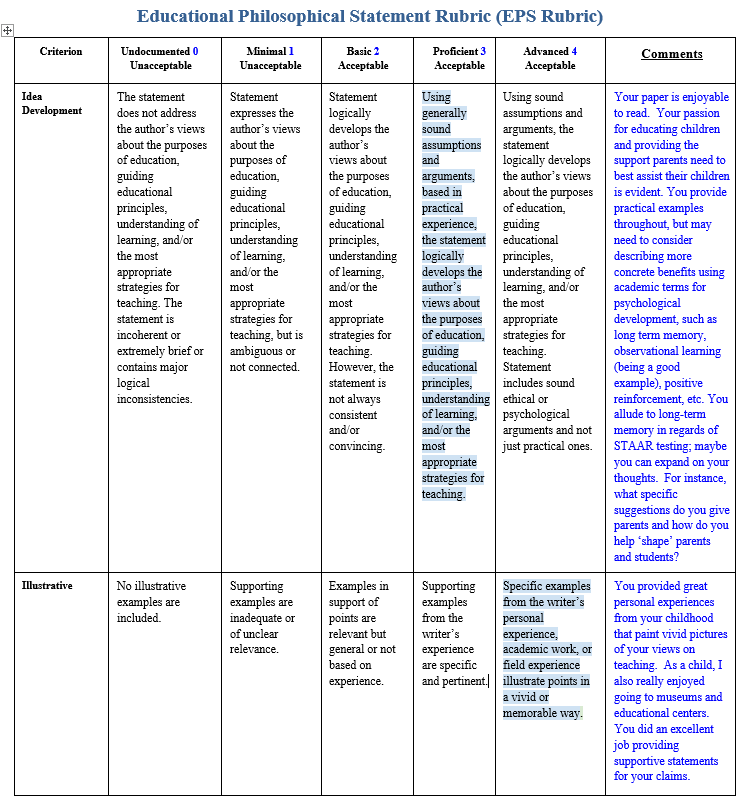
Unit 3: Peer Review of Educational Philosophy
The ‘Peer Review of the Educational Philosophy Statement’ is meant to provide constructive feedback on the overall structure, theme, supportive examples, mechanics, and grammar within the paper so that the writer is able to improve the quality of their paper. The ‘Peer Review’ is also meant to make sure the writer followed every section of the rubric.
As a quick note, the person assigned to review my paper was not able to do so, which is why I have provided the peer review I completed while reading Christian Ward's Educational Philosophy Statement.

Unit 4: Final Draft
This final version of my ‘Educational Philosophy Statement' utilizes sound arguments that are logically developed to showcase my “voice” or rather my “passionate perspective” on the purpose of education as well as the strategies and tools I will utilize in the future to aid in my students’ learning. Arguments are supported by examples from my previous experiences with different activities and my familial background. My paper is also clear and well organized while still following the appropriate academic style.
Tayci Wallace
Prof. Robert Wolfe
ETEC- 424 –1W
27 June 2019
My Educational Philosophy Statement
Ever since I was born, I have been surrounded by educators. My mother, sister, sister-in-law, aunt, and even my cousin-in-law are, or have been public school teachers. These women have taught different subjects and varying age groups which means I was exposed to numerous, diverse teaching perspectives throughout my childhood. Despite growing up with a large group of teachers when I was a kid, I never wanted to become a teacher; in fact, I tried my best to avoid the education career choice. In spite of my early distaste of the idea of me teaching, as I grew older, I began to appreciate the strength, patience, and dedication I observed many teachers put into their job. My ever-growing respect soon evolved into a desire to become someone that possessed such qualities and someone who could aid in students’ learning and ability to reach their developmental, emotional, and academic goals.
I have taken much of my inspiration from my mom who never missed a day of class and always put in long hours to make sure she was able to provide the tools her students needed to succeed. My mom is a retired middle school science teacher who taught mainly sixth and seventh graders over the course of thirty-one years and as far back as I can remember, her classroom, activities, and labs were always colorful, interactive, and engaging. The colorful posters and decorations not only served to create a more positive, engaging space, they also served as teaching tools that provided content/instruction. Many teachers like my mother utilize decorative teaching tools in an effort to make teaching and learning fun and inspirational, which is the specific goal of being an educator; one who finds new and innovative ways to keep learning interesting and students engaged. I plan to incorporate these tools in my own classroom.
Along with making learning engaging, a teacher’s most important job is guiding students and aiding in their development as future productive citizens by providing them with the tools and techniques they need to continue their learning throughout their life and ability to make sound, socially-responsible decisions and choices. As a future educator, I value the teacher’s role in establishing educational foundations for students, and, based on my past observations, the most effective ways to construct this foundation is to provide a positive learning environment while maintaining high, yet achievable standards for their students. Teachers also function as administers for more constructive social experiences so in the future, I hope to utilize different types of collaborative labs and group projects that will aid in developing strong communication skills and team work that prepare students for the future workforce. Such group activities in which I participated that stick out in my memory include bar-code scanner scavenger hunts where I worked with peers to answer questions encoded in each barcode placed throughout the classrooms and halls. Labs and group projects are other collaborative experiences I recall as well as numerous presentations we developed to demonstrate content mastery or application of subject matter content. These experiences helped me develop communication and cooperative skills that enhanced my ability to work with a team that I now utilize in college when I work on collaborative projects.
During one academic school year, a wide range of topics and information is presented at a high pace, making it difficult for students to process and cement the lessons into their long-term memory. In order to combat this, teachers must create relevant, memorable lessons, projects, and activities that provide a tangible memory and experience that will ‘stick with’ the students and provide future inspiration and a point of reference to which they can look back upon. The more personally relevant the activity/lesson, the more likely a student will internalize the learning experience. Instructional and learning strategies that helped me process and remember information most effectively were the colorful posters and comic strips, interactive notebooks, lab books, and presentations I created and published, such as Power Points, Google Slideshows, Prezi presentations, and YouTube videos. When a teacher puts in the time and effort to develop and find meaningful lessons, projects, and activities as well as provide quick and constructive feedback, that teacher significantly increases the chance that students will understand and retain content taught. These instructional practices strongly aid in long-term memory development, make information easier to digest, and promote the development of important organization, social, cooperative, and communication skills. For me, the most rewarding outcome would be students who enjoy learning and are able to apply what they learned from activities in lessons I provided in their academic classroom. Even more rewarding is when students develop knowledge and skills they will use the rest of their everyday lives and when they become lifelong learners.
Teaching is a challenging job and with the ever-growing population, a teacher needs to be able to adapt and grow along with it. The ability to adapt and apply new techniques, tools, and methods of teaching are the most useful traits a teacher can possess as they aid in the development of individualized learning methods that are highly beneficial to students. Teaching requires perseverance, patience, and a determination to support students, as well as serve as a role model and a source of guidance students can turn to and depend upon. As long as a teacher stays genuine and positive, students will sense the teacher’s passion, which will motivate and inspire them to work harder to learn and strive for excellence. Students are the future for our society, so future educators have a huge responsibility they should not undervalue nor take for granted.